

In Colorado, obtaining a Federal Firearms License (FFL) is a key step for anyone looking to engage in the sale, service, or manufacture of firearms. The process of acquiring an FFL can be complex and requires an understanding of state and federal regulations.
The role of an FFL is critical throughout the United States, where adherence to firearm laws is strictly monitored. Obtaining the FFL license is not only about gaining the license itself but also about understanding the responsibilities that come with compliance and following federal law.
Throughout Colorado, the requirements and interests related to firearms vary. This guide is designed to provide clear information for firearms dealers applying for an FFL. We will navigate through the steps of the application process, ensuring that you meet all federal and local requirements set by Colorado law and the federal government.
Step-by-Step Guide to Obtaining an FFL in Colorado
Applying for an FFL license in Colorado requires careful attention to detail and adherence to several key steps. This guide outlines the steps in the application process, providing clarity and guidance for aspiring gun owners.
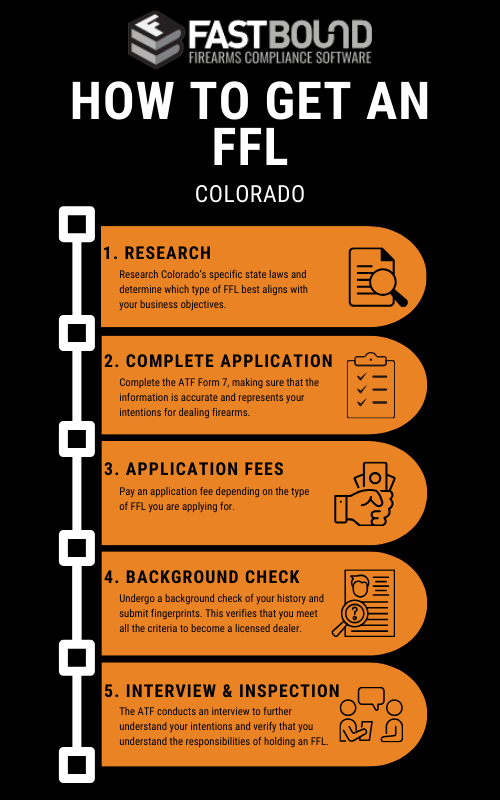
Step 1. Research
The first step is one of the most important. It involves gaining an understanding of the different types of FFLs and determining which one aligns with your business objectives. You should also research the specific requirements and regulations of Colorado state and federal laws. This is fundamental to ensuring that your business operations comply with all legal standards.
Step 2. Complete the Application
Once you understand the requirements, the next step is filling out the ATF Form 7. This form is the official application for the FFL and requires detailed information about your personal background, your business, and the specific details of your intended firearm activities. You should make sure that all documentation is accurate and prepare for additional information like local zoning laws or other relevant permits.
Step 3. Application Fees
You will have to pay a fee with your application, which varies depending on the type of FFL you apply for. It’s important to understand this cost structure and make sure you’re fully prepared before proceeding.
| FFL Type | Application Fee | Renewal Fee | Years |
| Type 01 | $200 | $90 | 3 |
| Type 02 | $200 | $90 | 3 |
| Type 03 | $30 | $30 | 3 |
| Type 06 | $30 | $30 | 3 |
| Type 07 | $150 | $150 | 3 |
| Type 08 | $150 | $150 | 3 |
| Type 09 | $3,000 | $3,000 | 3 |
| Type 10 | $3,000 | $3,000 | 3 |
| Type 11 | $3,000 | $3,000 | 3 |
Step 4. Background Check
After the application process, you’ll undergo a thorough examination of your background history and submit your fingerprints. The purpose of the background check is to verify that you meet all the legal criteria to become a licensed gun dealer. The ATF takes this step very seriously to ensure public safety and responsible gun ownership.
Step 5. Interview and Inspection
After the background check, you will have an interview conducted by the Industry Operations Investigator at the Bureau of Alcohol, Tobacco, Firearms, and Explosives (ATF). The interview serves as a review for your application, discussing the legal responsibilities of holding an FFL and confirming your understanding of all ATF regulations. Law enforcement officers play an important role in this process because it’s an opportunity for you to show your knowledge and preparation.
Obtaining an FFL can be a challenging and complex process, but with the right tools and knowledge, it’s a straightforward process.
License Types and Their Relevance in Colorado
Understanding the different types of FFLs and their specific applications is an important part of establishing a firearms business. Each type of FFL caters to particular aspects of firearm sales. It’s crucial to select the right type that aligns your business with state and federal regulations.
Type 01 FFL – Firearms Dealer
The Type 01 license is ideal for those wanting to engage in the private sale of firearms. It covers the sale of rifles, shotguns, and handguns, and is the most common type for gun shops. It doesn’t permit manufacturing or dealing in destructive devices.
Type 02 FFL – Pawnbroker in Firearms
Type 02 is designed for pawn shops and FFL dealers, allowing them to pawn or sell their firearms to the public.
Type 03 FFL – Collector of Curios and Relics
The Type 03 FFL is for individuals interested in collecting firearms. It’s important to note that this license is for collecting purposes only and doesn’t authorize business activities related to firearms.
Type 06 FFL – Manufacturer of Ammunition
Type 06 is specific to the manufacture of ammunition. It’s a suitable license for those who want to manufacture and sell ammunition, but not for the manufacture of the firearm itself.
Type 07 FFL – Manufacturer of Firearms
For those looking to manufacture firearms, the Type 07 FFL is the appropriate choice. It allows for the manufacture and sale of firearms and ammunition in Colorado.
Type 08 FFL – Importer of Firearms and Ammunition
The Type 08 is for businesses that intend to import firearms and ammunition into the United States. This is relevant for businesses that plan to import firearms from international markets.
Type 09, 10, and 11 FFLs – Destructive Devices and Other Specialized Categories
Type 09, 10, and 11 licenses are for more specialized categories. They allow the sale, manufacturing, and importing of destructive devices and armor-piercing ammunition. These categories are less common in the general firearms market.
Selecting the correct FFL is crucial for your business’s legal operation and compliance. Each license type serves a specific purpose and comes with its own regulations and rules for staying compliant.

Understanding Colorado’s Requirements for FFL Holders
For individuals wanting to become Federal Firearms License holders in Colorado, it’s important to understand specific state requirements that might be different from federal law. Colorado has its own set of rules that FFL holders must adhere to with the transfer of firearms.
Compliance with State and Federal Laws
FFL holders in Colorado must comply with federal and state laws. This includes adhering to regulations related to the sale, distribution, and record-keeping of firearms transactions. Understanding these laws is essential for operating your firearms business without encountering legal complications.
NICS Background Checks and Record-Keeping
As an FFL holder, you are required to conduct background checks on potential buyers using the National Instant Criminal Background Check System (NICS). Record-keeping is also important. This involves maintaining accurate records of all firearm transactions, including purchases and sales. These records must be readily available for inspection by law enforcement agencies.
Firearm Transfer Fees
An FFL request often involves paying a firearms transfer fee. In Colorado, these fees vary based on the firearm you have and the details of the transaction. You should be aware of these fees and stay informed to maintain a trustworthy business.
Reporting Lost or Stolen Firearms
In the event of a lost or stolen firearm from your inventory, Colorado law requires you to report it to local law enforcement and the ATF. Timely reporting is a legal obligation and is an important step in preventing firearms from falling into the wrong hands.
FastBound’s Role in Simplifying Compliance for FFL Holders
FastBound’s software is a pivotal tool for FFL holders across the U.S., specifically in the realm of regulatory compliance. In the complex world of firearm laws and ATF regulations, our software offers a streamlined and innovative solution that reduces the burden of compliance on individuals. By automating and organizing key aspects of the ATF compliance process, FastBound ensures that every licensed dealer can focus more on their business and less on legal regulation.
We revolutionize the process with our digital ATF Form 4473, which saves time and enhances accuracy for people applying for their FFL. We provide accurate and detailed record-keeping, efficient serial number tracking, and inventory management, making sure all records are maintained and easily accessible.
When you partner with FastBound, you join a community with more FFLs than any other compliance software provider. We are the most innovative solution that helps you navigate compliance in the firearm industry. Reach out to FastBound today to learn how our compliance software makes your journey even easier.
Resources:
- Bureau of Alcohol, Tobacco, Firearms, and Explosives. https://www.atf.gov/
- Colorado Department of Public Safety. https://publicsafety.colorado.gov/colorado-gun-laws
- FastBound. https://www.fastbound.com/
